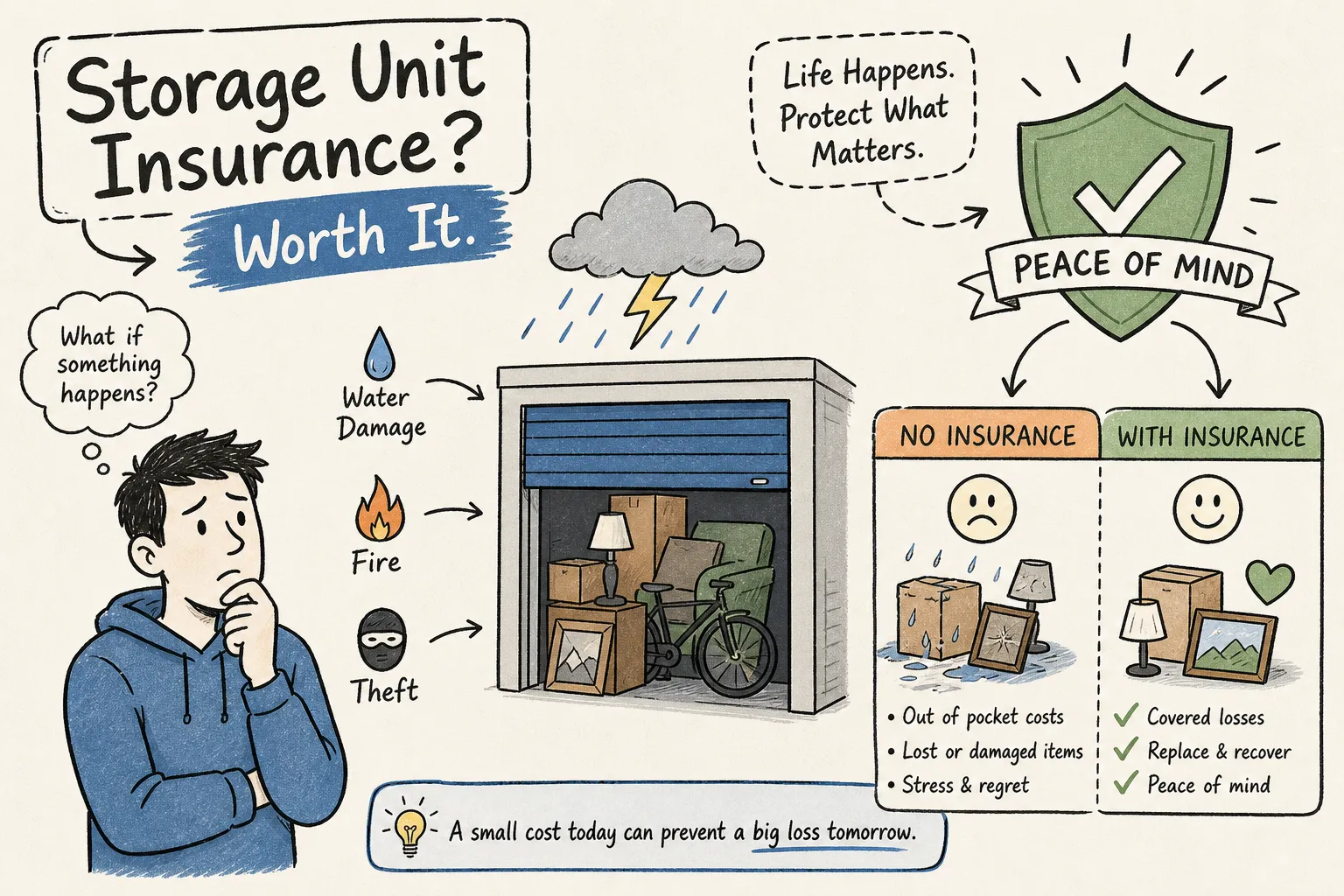
Do I need insurance for a storage unit? This is a question we routinely hear from potential customers at Pete’s Place Storage in Lillington, NC. You have taken the time to research a safe, secure facility, but what does that actually mean for your belongings? Many storage facilities require tenants to carry some form of coverage, and those that don't still strongly recommend it. Your lock and the facility's cameras protect the building, however, they don't reimburse you for a single damaged box. This guide covers what's actually required, what your existing policy may already cover, and how to close any gaps before you move in your first item.
Getting this right doesn't need to be complicated. We are here to make it easier than ever.
Many storage facilities include a clause in their rental agreement requiring tenants to maintain active coverage for the full rental term. This is not a legal mandate in most states. It is a lease condition. Show up without coverage, and the facility may automatically enroll you in their own protection plan and add the cost to your monthly bill.
Facilities commonly accept a declarations page from a current homeowners or renters policy, a certificate of insurance issued by your insurer, or enrollment in the facility's own tenant protection plan. Proof is typically required at signing. A standard insurance ID card usually won't work because it doesn't show personal property limits or confirm storage-specific coverage.
A facility can require you to have coverage, but it generally cannot force you to buy its specific plan. If your existing homeowners or renters policy qualifies, you have every right to use it. Know this going in so you don't pay for coverage you already have.
Both homeowners and renters insurance typically extend to belongings stored off-site, but usually only up to about 10% of your personal property coverage limit (according to Nationwide). For a nearly empty unit, that may be enough. For a full household of furniture, appliances, and electronics, it often is not.
Fire, theft, vandalism, lightning, and sudden water damage from a burst pipe are typically covered under standard homeowners and renters policies. Flooding, mold, pests, earthquakes, and gradual deterioration are commonly excluded. Mold and pest/vermin damage are also frequently excluded from standard policies—another reason many customers choose a dedicated tenant protection plan. Liberty Mutual's published policy guidance notes that a missing padlock alone may not satisfy your insurer, documented forced entry is typically required.
Cash, jewelry, firearms, collectibles, and fine art typically carry their own lower sublimits under any personal property policy, whether the items are at home or in a unit. According to Nationwide and American Family Insurance, these categories are among the most common sources of coverage surprises. If you're storing anything in those categories, your off-premises coverage may fall short faster than you expect.
This is the most common misconception about self-storage. Video surveillance, coded gate access, and well-lit loading areas deter theft and help document a loss after it happens. They do not pay for your belongings.
If someone breaks into your unit, the security footage may help law enforcement. It won't put money in your pocket.
Most storage leases limit or waive the facility's liability for damage to tenant property. The facility's property insurance covers the building and its infrastructure, not the contents of your individual unit. That distinction is exactly why tenant coverage is treated as a separate responsibility. The facility protects its asset; you protect yours.
Tenant protection plans typically cover fire, smoke, theft with forced entry, vandalism, wind, hail, and sudden water damage from a burst pipe or sprinkler discharge. Standard exclusions on many plans include flooding, earthquakes, and high-value item categories. At Pete’s Place Storage, our tenant protection plans cover perils that many other facility plans exclude, including vermin and mold. For full details on what is covered, visit our Tenant Protection page or contact us.
Actual cash value pays what your item is worth today after depreciation. Replacement cost pays what it costs to buy a comparable new item, without subtracting for age or wear. The North Carolina Department of Insurance notes that some policies pay actual cash value upfront and release the withheld depreciation only after you replace the item and submit receipts. For anything more than a couple of years old, replacement cost coverage is worth the slightly higher premium.
| Coverage option | Typical monthly cost | Common coverage limits | Notable exclusions |
|---|---|---|---|
| Facility-provided tenant protection plan (Pete's Place Storage) | Varies by facility and plan tier. Contact us for current rates. | Varies by plan tier | Flood and earthquake are commonly excluded. Unlike many other plans, our plan also covers vermin and mold. High-value items may have limits. See full details on our Tenant Protection page. |
| Third-party standalone self-storage policy | Varies by insurer and coverage level | Varies by policy | Flood, mold, pests, vermin, high-value items, and earthquake are commonly excluded (coverage depends on the specific policy) |
| Existing renters or homeowners policy | No extra premium | Typically 10% of personal property limit (e.g., $5,000 on a $50,000 policy), per Nationwide | Flood, mold, pests/vermin, high-value sublimits; deductible still applies. Off-premises coverage is often limited. |
Confirm whether off-premises storage coverage is included, what the limit is, and which perils are covered.
Estimate the dollar value of everything going into the unit. Take photos, note serial numbers on electronics, and keep a simple list somewhere accessible. This documentation isn't just for picking the right coverage level, a theft or damage claim with no inventory record takes longer to process and often results in a lower payout. Do this before the first box goes in.
If your existing coverage is adequate, bring your declarations page when renting. If there's a gap, our tenant protection plan is designed to be straightforward and affordable. A third-party standalone policy can make sense when your stored items exceed the facility plan's limit.
Storage unit insurance is either required by your lease or the most practical step you can take before renting. Your existing renters or homeowners policy may already cover you for some scenarios, but the off-premises limit and the list of excluded perils are easy to overlook until you actually need to file a claim.
The cost of a basic protection plan is low. The cost of discovering you had no coverage after a loss is not.
Before your first load-in day, call your agent, estimate the value of what you’re storing, and get something in place. If you have questions about coverage options at Pete’s Place Storage, contact us at (910) 984-8789 (call or text). We are happy to walk you through it.
No; cameras, locks, and lighting deter theft and can document a loss, but they do not provide reimbursement for your belongings. The facility's property insurance covers the building and infrastructure, not the contents of your unit.
Flood and earthquakes are commonly excluded from most plans. Mold and pest/vermin damage are also frequently excluded from standard homeowners, renters, and many facility plans. Our tenant protection plan covers items frequently excluded from other plans such as vermin and mold. See our Tenant Protection page for the full list of covered perils and any exclusions.
